A trackless train that runs perfectly on flat, wide promenades can struggle the moment the route includes a gradient, a narrow lane, or a series of tight turns. Those conditions change the power requirement, the wheelbase, the seating layout, and even the choice between electric and diesel drive. This guide explains how to specify a trackless train for slopes and narrow roads so it performs reliably every day.
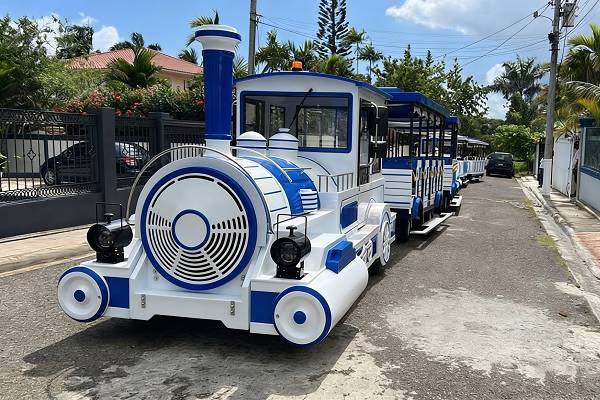
Match Power and Torque to the Gradient
Slopes are the first variable to check. A train carrying 60 passengers up a sustained incline needs considerably more torque than the same train on level ground, and batteries discharge faster under load. Ask the manufacturer for the maximum gradient the model can climb when fully loaded, and compare that figure with your steepest section. A route that climbs in short bursts is easier on the drive system than a long continuous ascent, so consider splitting a steep climb into stages.
Narrow Roads: Width, Passing Points, and Clearance
Measure the narrowest point of the route, not the average width. Add the vehicle’s mirrors, body overhang, and a safety margin for pedestrians, then check whether two trains can pass or whether the route must operate as a single-direction loop. Passing points, one-way operation, and turning bays solve most narrow-road problems. Remember that the route also needs clearance for maintenance access and emergency vehicles.
Turning Radius and Train Length
Every additional carriage lengthens the train and enlarges its turning circle. If your park has frequent turns, shorter trains with a tighter trackless train turning radius will follow the route more smoothly and keep passengers comfortable. Provide the manufacturer with a plan showing each corner, and ask for the minimum turning radius for each configuration you are considering. Where space is very tight, two smaller trains often outperform one long train.
Suspension, Tires, and Passenger Comfort
Sloped and uneven surfaces demand better suspension. Pneumatic or soft-ride tires absorb imperfections in the paving, and well-damped axles prevent the rocking motion that makes passengers uneasy on curves. Check how the carriages are coupled: flexible couplings handle turns better than rigid ones and reduce wear on the chassis. Comfort matters commercially, because families decide whether to ride again based on how the journey felt.
Battery Range on Challenging Routes
Gradients, frequent stops, and heavy loads all increase energy consumption. Calculate the realistic range for your specific route rather than relying on the ideal figure on level ground, and confirm whether the train can complete a full operating day with one charging window. Diesel solutions remain practical for long mountain routes and remote sites where charging infrastructure is limited, and a diesel trackless train for scenic spots can be the safer choice where terrain is severe.
Test the Route Before You Buy
Where possible, ask the manufacturer to review a route plan with gradients, corner radii, and surface types, or to simulate the journey with the intended configuration. Confirm the train’s performance figures at full load, check braking on descents, and plan where drivers can pause safely. Testing the plan on paper is inexpensive; discovering a problem after delivery is not.
Choosing a trackless train for difficult terrain comes down to four numbers: maximum gradient at full load, minimum route width, smallest turning radius, and realistic daily range. Work with an experienced Dinis trackless train factory that can match the vehicle to your route, and review how the modern trackless road train is engineered for flexibility. To discuss gradients, capacities, and drive options, visit https://www.dinistrains.com/trackless-train-rides/ and share your route plan.