Mall operators face a straightforward question when planning a train service: buy one large train that carries everyone at once, or several smaller trains that depart more often. The answer affects waiting times, staffing, maintenance, and the passenger experience across the whole shopping day. This article compares the two approaches for a mall trackless train fleet.
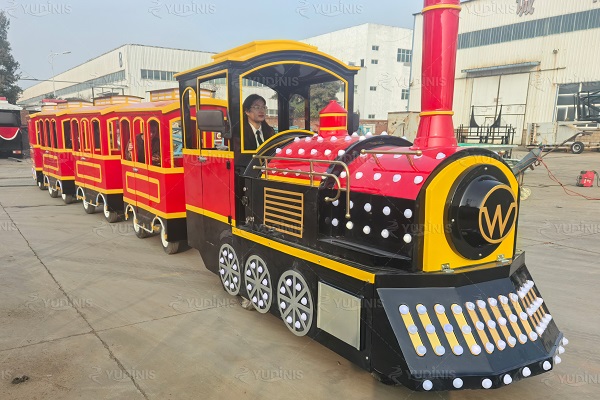
Start with Capacity and Waiting Time
Passengers judge a train service by how long they wait, not by how many seats it has. One 40-seat train departing every 15 minutes moves 160 passengers per hour; two 20-seat trains departing every 8 minutes move about 300. Shorter, more frequent departures feel better to shoppers and encourage repeat use during the same visit, particularly for families who ride between the food court and the anchor store. Convert seat numbers into hourly throughput before comparing prices.
The Case for One Large Train
A single large train is efficient in staffing and maintenance: one driver, one charging routine, and one set of running gear serve more passengers. It also makes a stronger visual statement on the mall’s main concourse and can be branded as the centre’s signature service. Where the route is wide, the corridors long, and visitor numbers predictable, one large train often delivers the lowest operating cost per passenger. It suits a mall train capacity planning exercise where the peak periods are well understood.
The Case for Several Smaller Trains
Smaller trains turn more easily on tighter mall corridors, can serve different zones simultaneously, and reduce waiting time. They also spread risk: if one unit needs service, the route continues. For centres with several entrances, branching corridors, or an atrium that limits turning space, a fleet of smaller trains is usually more practical. A modern trackless train rides for malls configuration with quick-charge batteries makes running two or three units straightforward.
Staffing, Charging, and Downtime
Every additional train adds a driver, a charging slot, and inspection time. Where labour is expensive, one large unit is simpler to operate; where the mall trades long hours every day, a fleet provides the flexibility to keep a train running during charging breaks. Plan charging points near the depot and confirm that the electrical supply can handle simultaneous charging without disrupting other operations.
Cost and Revenue Balance
Purchase cost per seat is usually lower on a large train, but a small fleet can generate more revenue through shorter waits and better coverage of the centre. Model both options against expected daily passengers and the average ticket price; in many malls, the difference in revenue over one season pays for the additional unit.
A Practical Compromise
Many operators choose a middle path: one larger train for the main loop during peak trading hours, supported by a smaller train for secondary corridors and weekend demand. This keeps waiting times low without over-investing, and it lets the operator test demand before expanding the fleet.
Whether one large train or several smaller units are right for your centre depends on corridor width, visitor flow, and operating hours. Work with an experienced Dinis shopping mall train maker that can model throughput for your route, and look at how a modern mall train service is integrated into visitor circulation. To compare capacities and prices, visit https://www.dinistrains.com/trackless-mall-train-for-sale/ and share your mall layout.